

Navigating Fla. Stat. 768.0706 (HB 837) Compliance: A Practitioner's Guide for Property Owners
Most property owners who come to us with questions about Florida Statute 768.0706 have already read the statute itself or a summary prepared by their attorney or insurance advisor. They understand the general proposition: implement certain security measures, obtain a CPTED assessment, train your employees, and the property receives a presumption against liability for criminal acts committed by third parties. What they typically do not understand - and what the statute does not make obvious - is the sequence of practical decisions involved in getting from intent to defensible compliance, or the points where a seemingly reasonable shortcut can quietly undermine the entire effort.
This page is structured around those decision points. Our intent is not to restate the statute or duplicate the detailed technical guidance available in our six-part compliance guide on cisworldservices.org , but to walk property owners through the compliance pathway in the order decisions actually present themselves - highlighting the places where we've seen clients make costly mistakes and the considerations that separate a compliance posture built to withstand litigation from one that merely appears adequate on the surface.
The First Decision: Is Compliance Worth Pursuing?
Before committing resources, every property owner should evaluate whether the liability protection offered by Fla. Stat. 768.0706 justifies the investment their specific property will require. The statute's presumption against liability is a powerful shield - particularly for properties in high-crime areas or those with a history of premises liability claims - but achieving it is neither free nor trivial. Based on our experience conducting assessments on over three hundred Florida multifamily properties since the statute's passage in 2023, owners should budget approximately $10,000-15,000 for the CPTED assessment and associated legal costs, with additional capital improvement costs that vary depending on existing conditions.
For properties where the risk profile is low and insurance costs are already manageable, it may be prudent to investigate the anticipated insurance premium reductions before committing. For others - particularly those with persistent concerns about crime in surrounding neighborhoods or a history of expensive litigation - the capital investment of compliance may be marginal when measured against the exposure of a multi-million-dollar jury verdict. Several CIS clients have elected to pursue compliance across their entire Florida portfolio primarily in anticipation of favorable insurance adjustments, treating the process as a long-term cost-reduction strategy rather than a one-time compliance exercise.
Understanding What the Statute Actually Requires
Fla. Stat. 768.0706 organizes compliance into three categories under subsection 2, each codified in its own paragraph. Paragraph A defines seven physical security measures the property must substantially implement. Paragraph B requires a crime prevention through environmental design (CPTED) assessment conducted by a qualified Florida CPTED Practitioner designated by the Florida Crime Prevention Training Institute (FCPTI) or a law enforcement agency, with the property remaining in substantial compliance with that assessment going forward. Paragraph C requires proper crime deterrence and safety training for all employees.
As an important and often overlooked point: the statute places the burden of proof squarely on the property owner or principal operator to demonstrate compliance. This is not a situation where the plaintiff must prove you failed - you must affirmatively show that you succeeded, which has direct implications for how you document every step of this process.
A common misconception we encounter is the belief that compliance with Paragraph A's seven physical security measures automatically satisfies CPTED requirements under Paragraph B. It does not. The Paragraph A measures - cameras at points of entry and exit, parking lot lighting at an average of 1.8 foot-candles at 18-inches, walkway and common area lighting, one-inch deadbolts, window locking devices, secured pool access, and peepholes - represent a statutory minimum. The CPTED assessment evaluates the property's broader environmental design against crime prevention principles including natural surveillance, natural access control, territorial reinforcement, maintenance conditions, and additional lighting standards that extend well beyond those seven items.
The Compliance Pathway: Sequence and Decisions
Preliminary Assessment of Paragraph A Conditions
Before engaging a Florida CPTED Practitioner, property management should conduct a self-assessment of the seven Paragraph A requirements. There is no practical value in paying for a comprehensive CPTED assessment if the property has not yet addressed basic physical security conditions that are straightforward to verify and correct internally - dwelling unit hardware, pool access control, and common area lighting controls. Our assessment preparation guide provides a detailed walkthrough of what property managers can check themselves and what requires professional measurement.
Two Paragraph A requirements - camera system coverage at points of entry and exit, and parking lot illumination levels - typically cannot be verified without professional assistance. Identifying every qualifying "point of entry and exit" under 768.0706(2)(a)(1) is often more complex than it first appears, particularly on properties bordered by public roads or in urban settings where multiple exterior doors open directly onto public space. On one property we assessed, what initially appeared to be three points of entry expanded to twenty when the property appraiser's map revealed that an interior road was actually public right-of-way, turning every sidewalk approaching a breezeway along that road into a potential point of entry requiring camera coverage. Parking lot illumination verification similarly requires systematic measurement with a calibrated light meter at the prescribed 18-inch height - a task beyond casual visual observation.
Engaging Legal Counsel and Selecting a Practitioner
A decision that deserves careful consideration is how to contract the CPTED assessment. We recommend engaging the assessment through legal counsel as a work product in preparation for litigation. Although contracting directly with a CPTED practitioner saves money in the short term, this approach can inadvertently create new legal exposure: if the assessment reveals significant deficiencies and the property owner subsequently decides not to pursue compliance - or is unable to make immediate improvements - the documented assessment could be discoverable in future litigation and used against the property. Routing the engagement through counsel provides a layer of attorney-client privilege protection over the assessment findings while the property works toward compliance.
The selection of the practitioner itself carries long-term consequences. The statute requires that the assessment be performed by a Florida CPTED Practitioner designated by FCPTI or by a law enforcement agency, and any error in credentialing invalidates the entire effort. Beyond credential verification, property owners should evaluate whether the practitioner's methodology, report documentation, and courtroom awareness are adequate for a report that may face adversarial scrutiny. We address the specific questions worth asking - and the red flags to watch for - in our assessment preparation guide , which covers practitioner vetting in detail.
Implementing Improvements and Establishing "Substantial Compliance"
After the CPTED assessment is complete, the property must act on the findings to demonstrate substantial compliance - a phrase the statute uses repeatedly but does not precisely define. This ambiguity is deliberate: the legislature did not require perfect compliance with every recommendation, recognizing that some proposed improvements may be impractical or disproportionate to their crime prevention benefit. The operative question for property owners is how to make defensible decisions about which improvements to implement and which to defer or decline, and how to document those decisions in a manner that will withstand scrutiny.
Our approach to this problem is to assign a multi-tiered cost-benefit ranking to each proposed measure in our assessment reports, providing property owners with a defensible basis for prioritization. Consider a property where a CPTED assessment recommends trimming or removing mature landscaping that obstructs natural surveillance along a perimeter sidewalk. If the vegetation is ornamental, long-established, and its removal would significantly affect the property's curb appeal, the owner may reasonably conclude that the crime deterrence benefit does not justify the cost and resident impact - and the cost-benefit ranking in the report provides a documented basis for that business decision. By contrast, the seven Paragraph A items should be treated as mandatory compliance requirements with no discretionary latitude; because these measures are specifically enumerated in the statute, courts are likely to treat them as necessary conditions regardless of the "substantially implements" qualifier.
Documentation is the mechanism by which compliance becomes provable. Every corrective action should generate a documented record tied to the relevant assessment recommendation - whether through the property's work order management system, a dedicated compliance tracking file, or both. A parallel compliance archive should maintain vendor contracts, installation records, photometric drawings, before-and-after photographs, and written policy documents. When improvements are made incrementally - such as upgrading light fixtures building by building - each phase should be documented with dates, specifications, and updated measurements where applicable. The objective is to assemble a record that can demonstrate, item by item, that each recommendation was addressed. In our experience, few things deter a plaintiff's attorney during discovery more effectively than receiving a CPTED assessment report accompanied by a comprehensive file of meticulous documentation establishing substantial compliance.
Employee Training Under Paragraph C
The third compliance obligation requires that all employees receive proper crime deterrence and safety training covering the principles, devices, measures, and standards described in Paragraph A, with the training curriculum reviewed at least every three years. After the January 1, 2025 compliance date, all new hires must complete the same training within 60 days. The Florida Crime Prevention Training Institute has published a model curriculum as a PowerPoint slide deck that serves as a reasonable foundation, and property owners who build their training program from this baseline can demonstrate alignment with the statutory intent. However, we advise extending the training content to include the property's specific CPTED maintenance obligations - landscaping standards, inspection protocols, camera system verification procedures - so that employees understand not only the Paragraph A requirements but the operational practices necessary to sustain compliance with the CPTED assessment over time.
Neither the statute nor FCPTI prescribes a delivery format, which provides flexibility. Some management companies incorporate the training into monthly group orientation sessions; others conduct standalone sessions with an instructor. For properties with high employee turnover or geographically dispersed portfolios, on-demand video-based platforms designed specifically for Fla. Stat. 768.0706(2)(c) compliance offer a practical alternative that simplifies onboarding - a new employee can complete training at a workstation as part of their first-week orientation without scheduling a group session or live instructor.
For clients that engage us for conducting their CPTED assessments, we provide this training free of charge through our online training platform, hb837training.com .
Regardless of the delivery method, maintaining records of training completion for every employee is essential. These records should be centralized and readily retrievable - not buried in individual personnel files - because training documentation will be among the first items requested if the property's compliance status is challenged.
Compliance Is an Ongoing Operational Commitment
The most consequential misunderstanding we encounter among property owners is the belief that compliance is a project with a completion date. It is not. The Paragraph A physical security measures require continuous maintenance - burned-out parking lot lights, an inoperative camera at a point of entry, or a pool gate with a failed access control mechanism can each represent a gap in compliance status that exists from the moment of failure until the moment of repair. Landscaping conditions addressed during the initial CPTED assessment will revert if ongoing maintenance does not conform to the assessment's specifications: shrubbery grows back above the two-foot threshold, tree canopies drop below six feet, vegetation encroaches on camera sight lines and light fixtures. These are among the most common CPTED deficiencies we observe on Florida multifamily properties , and in several assessments we have conducted, properties that had completed improvements only months earlier had already begun to drift out of compliance because landscaping contractors had not been directed to maintain the CPTED-specified conditions.
Properties positioned to sustain their compliance status treat these requirements as standard operating procedures rather than project milestones. Landscapers receive written instructions - integrated into the contract scope of work - for maintaining vegetation to the CPTED assessment's specifications. Maintenance managers conduct documented monthly inspections covering lighting operability, camera system functionality at designated points of entry and exit, pool access control serviceability, and physical conditions that contribute to environmental disorder. Camera systems are checked weekly with work orders generated immediately for any deficiencies. New employees complete training within the 60-day statutory window as a standard onboarding requirement, and the CPTED assessment is refreshed every three years with calendar reminders set well in advance of expiration. The organizations that execute this most effectively assign compliance tracking responsibilities at the corporate or regional level - not solely at the property level - ensuring accountability to senior leadership.
Critical Intervention Services has conducted CPTED assessments on over 300 Florida multifamily properties for compliance with Fla. Stat. 768.0706. Our Florida CPTED Practitioners hold current FCPTI designation, and our assessment reports are prepared with the rigor necessary to withstand legal challenge. To discuss your property's compliance pathway or to schedule an assessment, use the contact form below or call (800) 247-6055.
Frequently Asked Questions
What does Fla. Stat. 768.0706 require for multifamily properties?
The statute requires substantial implementation of seven physical security measures (cameras at points of entry and exit, parking lot lighting at 1.8 foot-candles average, walkway and common area lighting, one-inch deadbolts, window locking devices, secured pool access, and peepholes), a crime prevention through environmental design (CPTED) assessment by a designated Florida CPTED Practitioner or law enforcement agency, and proper crime deterrence and safety training for all employees.
How much does HB 837 CPTED compliance cost?
Property owners should budget approximately $10,000–15,000 for the CPTED assessment and associated legal costs. Additional capital improvement costs vary depending on existing conditions and property size. The cost-benefit calculation should weigh these expenses against the liability protection the statute provides and potential insurance premium reductions.
What is 'substantial compliance' under Fla. Stat. 768.0706?
The statute does not require perfect compliance with every recommendation in the CPTED assessment. Property owners must demonstrate a diligent effort to implement the seven Paragraph A physical security measures and the practitioner's CPTED recommendations. Decisions to decline specific improvements should be justified on a defensible cost-benefit basis.
Should I contract my CPTED assessment through an attorney?
Engaging the CPTED assessment through legal counsel as a work product in preparation for litigation is recommended. This provides attorney-client privilege protection over the assessment findings while the property works toward compliance, preventing a partially completed assessment from being used against the property in future litigation.
How often does the CPTED assessment need to be updated?
The statute requires that the CPTED assessment be no more than three years old. Properties should schedule an updated assessment well before the current one expires to maintain continuous compliance status.
Contact Us
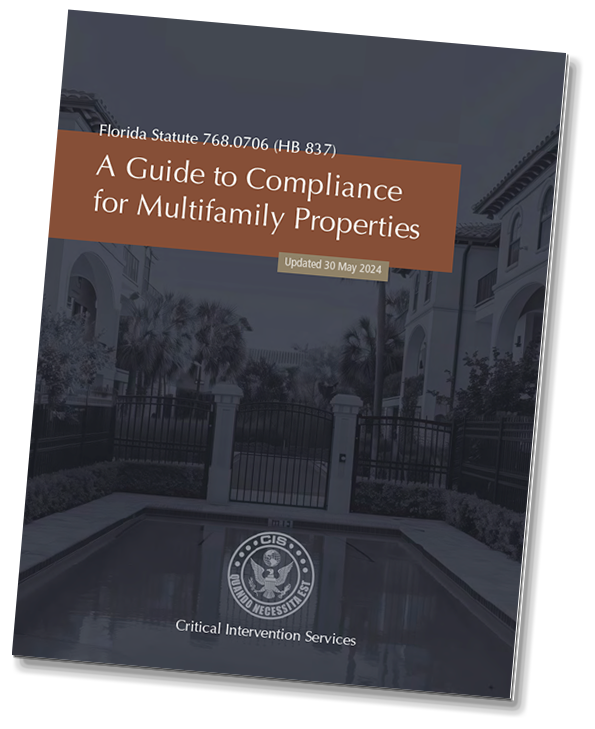
Download a PDF version of our guide to compliance with Florida Statute 768.0706