

Common CPTED Deficiencies in Florida Multifamily Properties: Observations from the Field
Most property owners who pursue compliance with Florida Statute 768.0706 have a reasonable understanding of what the statute requires - camera systems, parking lot lighting, deadbolts, a CPTED assessment, employee training, etc... What many do not anticipate is the range of environmental conditions that a CPTED assessment actually evaluates, or how frequently properties that appear well-maintained on casual observation turn out to have deficiencies when subjected to systematic professional inspection. The gap between what a property looks like in the eyes of management and what a systematic evaluation by a crime prevention professional reveals can be substantial.
Over the course of conducting CPTED assessments on more than three hundred Florida multifamily properties since the statute's passage in 2023, our team at Critical Intervention Services has documented a consistent set of recurring deficiencies - conditions that consistently appear across property types, management companies, and geographic areas. This article describes the most common categories of deficiency we encounter and identifies the patterns that cause individual problems to often compound into broader crime prevention and compliance vulnerabilities. Our intent is not to duplicate the compliance guidance available in our practitioner's guide to Fla. Stat. 768.0706 compliance or our assessment preparation guide , but to give property owners and management professionals a field-level view of what these problems actually look like - so they can recognize emerging conditions before they become assessment findings.
Vegetation Management and Natural Surveillance
Overgrown and poorly maintained landscaping is one of the most frequently encountered deficiency categories across the properties we assess. The guideline applied by Florida CPTED practitioners for vegetation management is known as the two-foot, six-foot rule: all ground-level shrubbery should be maintained at or below 24 inches in height, and all tree canopies should be no lower than six feet from the ground. Any vegetation that deviates from this guideline should be positioned at least 30 feet from parking spaces, pedestrian walkways, and outdoor activity areas. The Illuminating Engineering Society (IES) also publishes a similar guideline (three-foot, seven-foot rule), but the 2-ft/6-ft guideline promoted by the Florida Crime Prevention Training Institute (FCPTI) is the universal standard used by Florida CPTED Practitioners for ensuring natural surveillance - the ability of people to see clearly in all directions as they move through the property - in residential crime prevention contexts.
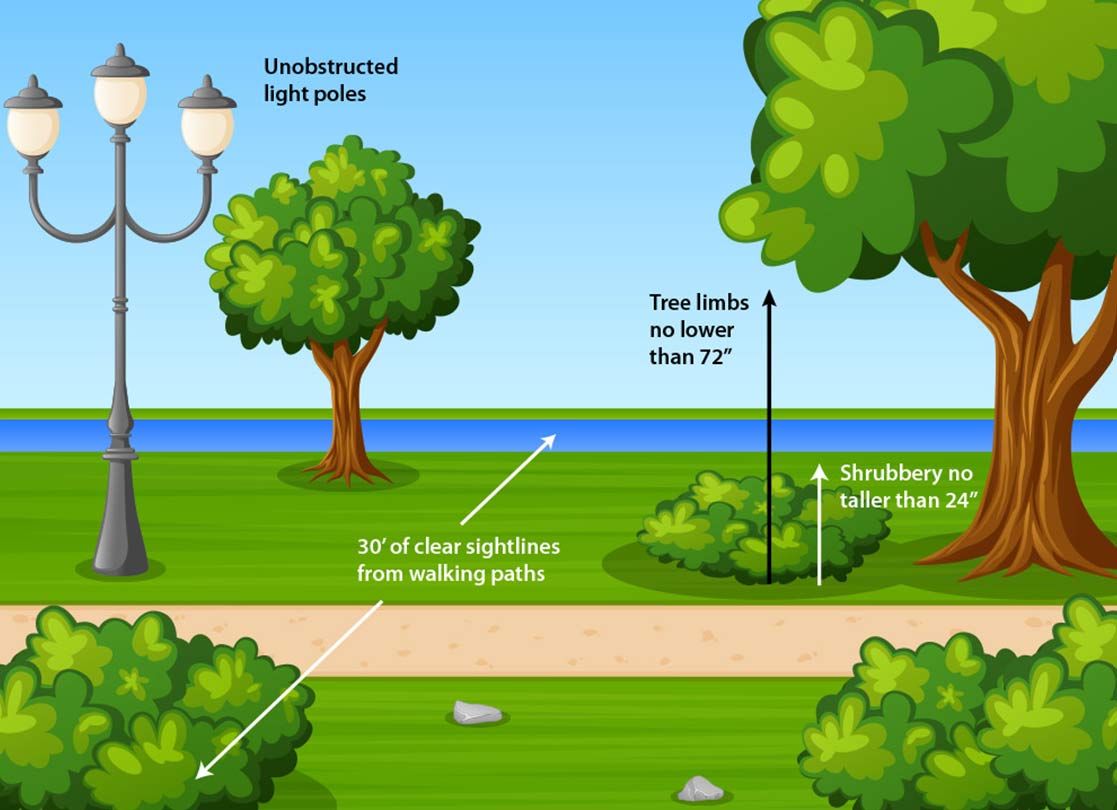
The purpose of these dimensional thresholds is straightforward: to ensure that a person walking along a sidewalk or through a parking area can see across landscaped areas well enough to recognize a potential offender nearby. When shrubbery reaches 40 to 50 inches in height, it provides effective concealment for an adult in a crouching position, and a pedestrian approaching from the opposite side has no ability to detect that individual until they are within arm's reach. As an example, we frequently encounter properties where ornamental hedges along entry sidewalks have grown dense enough and tall enough that a person standing upright on the far side is completely hidden from view - a condition that transforms what should be a routine walkway into a potential ambush trap.
The cause in most cases is not neglect but an absence of crime prevention standards during initial landscaping design, often compounded by an absence of specific instructions for landscaping contractors. Landscaping contracts typically specify mowing frequency, seasonal planting, and general pruning schedules, but they rarely include specific dimensional tolerances as defined by CPTED guidelines.
If the property does not address landscaping maintenance at the same time it acts on other CPTED assessment recommendations, it is often only a matter of time before the problems return. We have seen this pattern on several occasions: a property completes significant vegetation remediation following an initial assessment, and within six to twelve months, the conditions have reverted because the landscaping contractor was never provided with the height and clearance specifications from the report. The shrubbery is trimmed on schedule - it is simply trimmed to whatever height the crew considers aesthetically appropriate rather than to the threshold the assessment specified. The solution is a process correction rather than a maintenance correction: written contract specifications that reference the assessment's vegetation standards, ideally integrated into the landscaping scope of work so the requirements carry forward through contractor changes. Our detailed guidance on maintaining long-term CPTED compliance on cisworldservices.org addresses this in the context of ongoing operational procedures.
Obstructive vegetation can also create compounding problems with other environmental systems. Trees planted in close proximity to light poles and wall pack fixtures - a common design-phase oversight where photometric plans and landscape architecture plans are developed independently - will progressively obstruct illumination as they mature. We routinely encounter properties where the original lighting design would have produced acceptable measurements, but unchecked tree growth has reduced ground-level illumination to fractions of the design output. In these situations, areas near the base of parking lot pole lights may measure 0.0 foot-candles - despite the fixture being fully operational - because the tree canopy has completely enveloped the luminaire. These conditions do not develop overnight; they emerge incrementally over two to three growing seasons and are easy to overlook without systematic nighttime inspection.
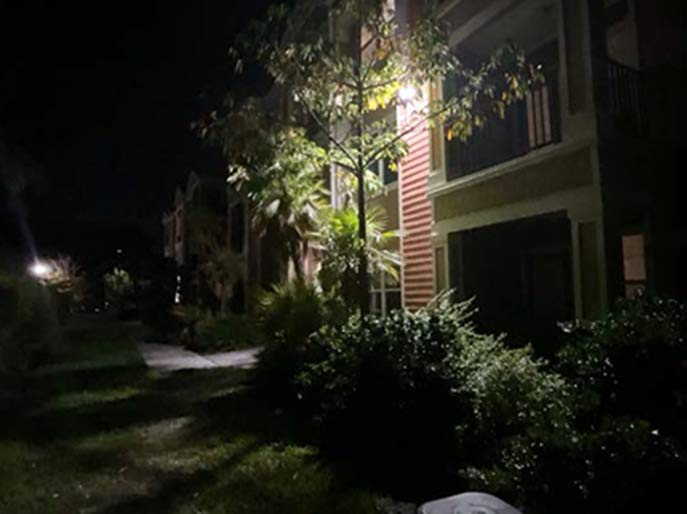
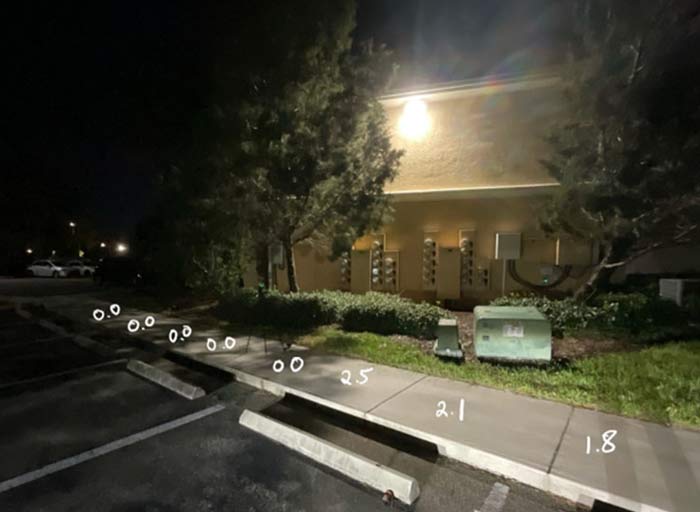
The same dynamic also affects camera sight lines: a tree branch growing across a camera's field of view, or a hedge rising to partially block a camera positioned to cover a sidewalk, degrades surveillance coverage without triggering any system alert. The camera continues to record; it simply no longer captures the area it was positioned to monitor.
Illumination Deficiencies
Fla. Stat. 768.0706(2)(a)(2) requires parking lot illumination at an average of 1.8 foot-candles at 18 inches above the surface - a threshold that establishes the statutory minimum but represents only one dimension of what a CPTED assessment evaluates. The Illuminating Engineering Society's guidelines recommend higher thresholds across different areas of the property: 3.0 foot-candles for parking lots with a maximum contrast ratio of 4:1, increasing to 6.0 foot-candles for enclosed parking garages; 1.0 foot-candle for general sidewalks; 3.0 foot-candles for common areas, outdoor assembly areas, entrances, and breezeways; and 10.0 foot-candles for mailbox areas, which receive a higher recommendation because they are predictable congregation points where residents are momentarily stationary and focused on retrieving mail rather than monitoring their surroundings. For CCTV and observational purposes, ASIS International also recommends at least 2.0 foot-candles for effective subject recognition.
Understanding the different types of lighting deficiency matters because each has different causes and different remedies. The most common category is obstructed illumination: fixtures that are operational and producing adequate output but whose light is blocked from reaching ground level by intervening objects - typically vegetation, as discussed above, but also architectural elements. As an example, we have assessed properties where wall pack fixtures were mounted directly above covered walkways, effectively illuminating the roof overhang while providing no meaningful benefit to the sidewalk surface below. In that situation, the most likely explanation is a disconnect between the original architects and the lighting designer.
Insufficient luminous flux - a technical term for inadequate light output from the fixture itself - presents differently. In these cases there are no obstructions; the fixtures are clean and unimpeded, but they simply do not produce enough illumination for the application. This is clearly evident when we encounter situations where lights are unobstructed and functioning, but most measurements are substandard.
Absent illumination - areas where no lighting exists at all - is a common problem in outdoor spaces where residents congregate: playgrounds, pavilions, outdoor seating areas, smoking areas, and community barbecue or picnic facilities. In some cases, management adds or designates these spaces after completing the original lighting design, and no one revises the lighting plan to account for them.
Degraded and entirely inoperative lighting is often the most serious category because it signals active maintenance failure rather than a design limitation. As an example, we've encountered several situations where buildings were so dark residents were forced to navigate to their front doors using flashlights on their phones. In one situation, neither the residents nor property management could clearly establish how long the condition had persisted, but conversations suggested at least two weeks. In this type of situation, the problem is not merely a CPTED deficiency - it represents a potential independent liability exposure regardless of the property's compliance status under the statute.
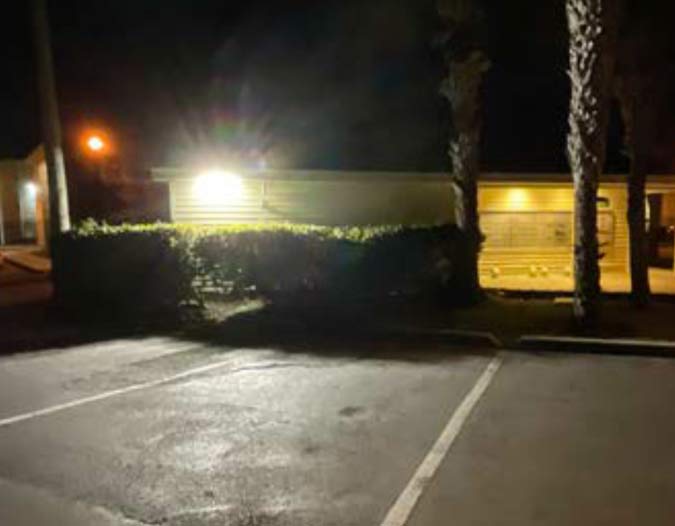
Glare is a particularly counterintuitive deficiency because it often results from a well-intentioned attempt to improve lighting conditions. In this case, maintenance personnel install supplemental fixtures to address dark areas but mount them at low elevation without cutoff shields, producing a light source that shines directly into the eyes of approaching pedestrians. The effect is the opposite of the intended improvement: the light blinds people to conditions in the surrounding area, and the space behind or adjacent to the fixture becomes perceptually darker than it would be without any supplemental lighting at all. The resulting high contrast ratio - exceeding the 4:1 maximum recommended by IES guidelines - significantly impairs a pedestrian's ability to recognize figures in the adjacent darker areas, defeating the purpose of the supplemental lighting entirely.
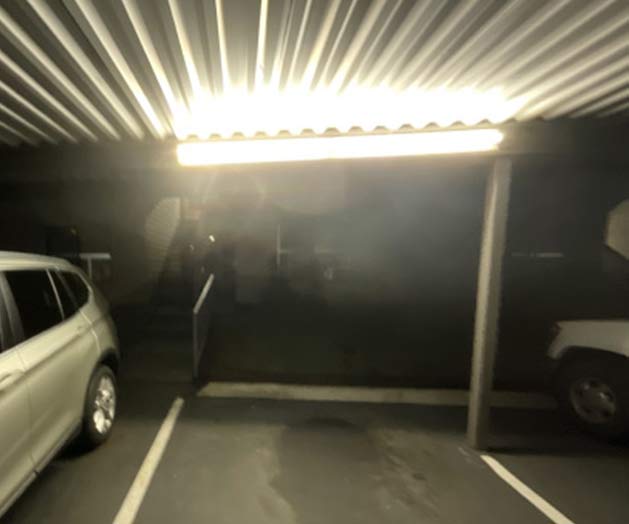
Surveillance System Deficiencies
Camera system deficiencies under Fla. Stat. 768.0706(2)(a)(1) generally fall into three categories: coverage gaps at qualifying points of entry and exit, physical obstruction of existing cameras, and inadequate footage quality or retention. The coverage gap issue is frequently a consequence of the statute's undefined use of the term "point of entry and exit" - a phrase that case law will likely need to resolve. Property operators who install cameras at their vehicle entrance drives and main pedestrian entry points may believe their coverage is complete, only to discover during the assessment that additional sidewalks, foot trails, or secondary access points along the property boundary also qualify. Our compliance process guide discusses a specific example where a single property's identified entry points expanded dramatically once the legal property boundaries were properly analyzed. Pending judicial clarification, the approach we apply during assessments is to treat any designed or established point of passage through the property line as a potential point of entry requiring camera coverage.
Physical obstruction of camera views - most commonly by vegetation - is among the easiest deficiencies to prevent and among the most frequently encountered. The problem develops incrementally: a camera installed with a clear field of view is progressively obstructed as nearby trees and shrubbery grow into the camera's sight line over one or two growing seasons. Because the obstruction is gradual, it rarely attracts anyone's attention - the camera continues to function, the DVR or NVR continues to record, and the system dashboard shows no errors. The deficiency only becomes apparent when someone actually reviews the footage and discovers that a camera monitoring a particular sidewalk or entry drive now captures a screen of leaves rather than the area it was positioned to cover. To address this concern, we recommend that properties conduct a weekly camera system check that includes reviewing actual footage from each camera - not merely verifying that cameras are powered and recording.
Footage quality and retention present a separate set of concerns. The statute requires that footage be retrievable for at least 30 days and of sufficient quality to assist in "offender identification and apprehension". Properties using motion-activated recording systems with limited storage capacity should be extra attentive to this issue: periods of elevated activity - holiday weekends, severe weather events, even a prolonged period of increased foot traffic - can consume storage faster than anticipated, overwriting older footage before the 30-day threshold. During assessments, we verify not only that the system is configured for 30-day retention but that actual footage from 30 or more days prior is in fact retrievable on demand. This verification occasionally reveals a gap between the system's configuration settings and its operational reality.
Dwelling Unit Hardware and Access Control
The dwelling unit security requirements under Paragraph A - one-inch deadbolts, peepholes, window and sliding door locking devices, and secured pool access - are the most mechanically straightforward compliance items in the statute. Nevertheless, issues do often arise warranting corrective action for compliance.
Inadequate deadbolt locks are rarely a concern on most properties we have assessed over the past few years. However, we have encountered situations where high-rise and mid-rise apartments were constructed with non-compliant ¾-inch deadbolts, and also situations on older properties where hardware that was originally installed to a uniform standard has been replaced piecemeal during years of unit turnover, with individual maintenance technicians selecting whatever replacement was available rather than maintaining a standardized specification. On a 200-unit property, this can produce a situation where the majority of units are compliant but a scattered subset - maybe 10 to 15 percent - have deadbolts with throws measuring less than one inch.
Peephole conditions deserve specific mention because the failure mode is often counterintuitive. The statute requires that each dwelling unit door be equipped with a peephole or door viewer where the door does not include a window or have a window adjacent to it. On some properties we assess, the peephole is physically present - the deficiency is that layers of paint applied during unit turnover preparation, or accumulated dirt and grease on the exterior lens, have rendered it functionally useless. Although the statute technically requires only that the peephole is present, the defensibility of a compliance claim weakens considerably if a plaintiff can demonstrate that residents were unable to effectively use the door viewers for their intended crime prevention purpose. Cleaning peephole lenses on both sides and verifying clear visibility should be a standard step during every unit turnover.
Window and sliding door locking devices present a different pattern. The most common deficiency is the use of removable locks - aftermarket devices that residents can detach and lose, or simply fail to reinstall after opening the window. Over multiple tenant cycles, these devices disappear from a percentage of units, creating compliance gaps that are invisible to property management unless someone physically inspects the hardware. Permanently attached locking mechanisms eliminate this failure mode entirely and should be specified as the replacement standard.
Pool access control deficiencies typically involve gates that are equipped with child safety latches that are locked and unlocked by management for unattended use by residents. In less frequent cases, the problem is broken latching mechanisms or inoperative mag locks.
Physical Disorder and Territorial Signals
Crime Prevention Through Environmental Design operates on the principle that the physical environment communicates information - to potential offenders as well as to residents and visitors - about whether a community is actively monitored and maintained. Physical disorder refers to the visible accumulation of damage, deterioration, and neglect: conditions that individually may seem minor but that collectively signal reduced territorial control. The concept is grounded in the broken windows theory, and its CPTED application is practical rather than metaphorical: the actual physical conditions of a property influence the actual decision-making of individuals contemplating criminal activity in that environment. A well-maintained property communicates to potential offenders that this community is attentive and organized; a disordered property communicates that it is not.
On multifamily properties, physical disorder often manifests in a recognizable pattern of conditions that we document during assessments: damaged or dangling breezeway signage and exit signs, window screens lying on the ground or visibly detached from frames, bent or damaged perimeter fencing, scuffed and deteriorating paint on building exteriors and stairwells, faded or broken property identification signage, and ground litter. None of these conditions directly enables criminal activity in the way that an inoperative camera or a failed light fixture does. Rather, their significance is cumulative: they establish an environmental appearance that signals to potential offenders that this is a community where management's attention to property conditions is low and where residents are disengaged from their surroundings.
Ground litter and uncollected trash warrant particular attention because they can become self-reinforcing. When isolated to specific buildings or areas, the condition is generally correctable through targeted maintenance intervention and resident communication. When the condition has become pervasive across the property, it typically reflects a cultural pattern that requires a more comprehensive management response than routine maintenance alone can address.
Structural Concealment Opportunities
Another CPTED problem is structural concealment - conditions created by the built environment itself that provide hiding opportunities for potential offenders. These include gaps between parking structures and adjacent walls, recessed areas behind utility equipment screening (air conditioning units, electrical equipment, etc.), and enclosed breezeway designs that restrict visibility at building entrances. Unlike vegetation problems, structural concealment cannot be corrected through maintenance; these conditions are embedded in the property's original design.
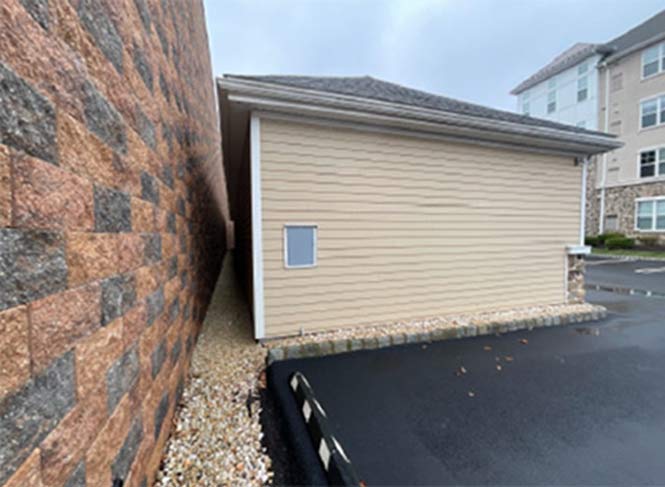
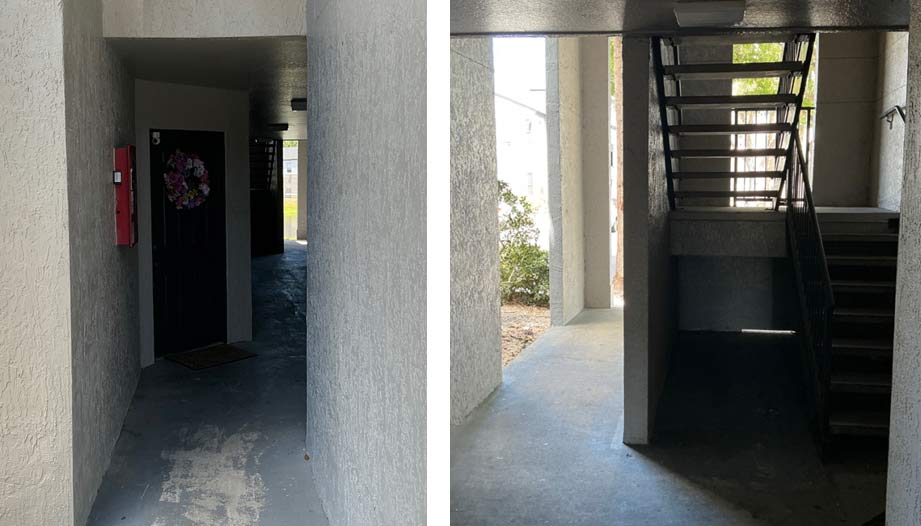
For new development, the preferred approach is to eliminate concealment opportunities during the design phase. For existing properties, the most practical remedy is often placement of convex safety mirrors at blind corners and transition points, combined with high-intensity illumination to reduce the area's attractiveness as a concealment position. Our assessment reports address structural concealment with an explicit notation that the condition cannot be changed through reasonable property improvements, accompanied by a cost-benefit ranking that reflects the practical limitations - an approach that preempts any challenge that the assessment failed to identify the problem.
Why Deficiencies Rarely Exist in Isolation
One of the most important observations from our field experience - and one that property owners should understand before their first assessment - is that CPTED deficiencies rarely appear in isolation. A property with overgrown vegetation is very likely to also have vegetation-obstructed camera views and vegetation-obstructed light fixtures, because the root cause - inadequate landscaping specifications and maintenance - affects all three systems simultaneously. A property where exterior lighting has been allowed to degrade is also likely to exhibit physical disorder conditions, because both reflect the same underlying pattern of deferred maintenance. The tendency to encounter multiple overlapping deficiencies on a single property is not coincidental; it reflects the fact that most CPTED deficiencies are symptoms of operational patterns rather than discrete equipment failures.
Mailbox structures provide a particularly clear illustration of how deficiencies compound within a single location. We frequently encounter mailbox areas presenting three or four simultaneous problems: an inoperative or degraded light fixture mounted on the structure, nearby pole lights whose illumination is blocked by the mailbox structure's own roof or walls creating shadows on the approach paths, no interior illumination within the structure itself, and vegetation encroachment reducing sight lines to and from the surrounding area. The IES recommendation of 10.0 foot-candles for mailbox areas reflects the elevated risk these locations present, yet they are among the most consistently under-illuminated spaces we measure across Florida properties. Addressing any single factor - replacing the inoperative fixture, for example - without also managing the tree canopy blocking the adjacent pole light and adding interior illumination produces a partial improvement that may still fall well short of adequate conditions.
The practical takeaway for property owners is that a systematic approach addressing underlying operational causes serves effective compliance far better than a piecemeal, deficiency-by-deficiency remediation strategy. Integrating CPTED vegetation specifications into landscaping contracts, establishing documented inspection protocols that cover lighting, cameras, hardware, and environmental disorder on a regular schedule, and assigning compliance tracking responsibilities at a management level with the authority to enforce corrective action - these are the operational commitments that sustain compliance over time. Properties that treat CPTED maintenance as part of standard operating procedure rather than as a periodic project are the ones we find in the strongest compliance posture when we return for updated assessments. Our compliance process guide discusses these ongoing operational requirements in detail.
Critical Intervention Services has conducted CPTED assessments on over 300 Florida multifamily properties for compliance with Fla. Stat. 768.0706, and we draw the deficiency patterns described in this article directly from that field experience. Our Florida CPTED Practitioners hold current FCPTI designation, our light meters are NIST-calibrated with automated data logging, and our assessment reports are prepared with the documentation standards and courtroom awareness necessary to withstand adversarial legal scrutiny. To discuss your property's conditions or to schedule a CPTED assessment, use the contact form below or call (800) 247-6055.
Frequently Asked Questions
What are the most common CPTED deficiencies on Florida apartment properties?
The most frequently encountered deficiencies during CPTED assessments under Fla. Stat. 768.0706 involve overgrown vegetation that obstructs natural surveillance and camera sight lines, inadequate illumination in parking lots, sidewalks, breezeways, and mailbox areas, camera coverage gaps at qualifying points of entry and exit, and physical disorder conditions including damaged signage, deteriorating fencing, and ground litter that degrades the property's territorial character.
How does overgrown landscaping affect CPTED compliance?
Florida CPTED practitioners apply a two-foot, six-foot rule requiring ground shrubbery at or below 24 inches in height and tree canopies no lower than six feet from the ground. Overgrown vegetation can obstruct pedestrian sight lines creating concealment opportunities, block camera views at points of entry and exit, and reduce ground-level illumination by enveloping light fixtures. These effects compound across multiple compliance requirements simultaneously, making vegetation management one of the highest-impact maintenance priorities.
What lighting standards apply during a Florida CPTED assessment?
Fla. Stat. 768.0706 requires parking lots to be illuminated at an average of 1.8 foot-candles at 18 inches above the surface. The CPTED assessment additionally evaluates lighting against IES guidelines for security-sensitive multifamily properties, which recommend 3.0 foot-candles for parking lots with a maximum 4:1 contrast ratio, 3.0 foot-candles for common areas and entrances, and 10.0 foot-candles for mailbox areas. Properties that meet the statutory minimum may still receive CPTED improvement recommendations based on these higher benchmarks.
Why do CPTED deficiencies tend to appear together on the same property?
Most CPTED deficiencies are symptoms of underlying operational and management patterns rather than isolated equipment failures. A property with overgrown vegetation typically also has vegetation-obstructed cameras and light fixtures, because the root cause — inadequate landscaping specifications — affects all three systems simultaneously. Similarly, degraded lighting often coincides with physical disorder conditions, as both reflect deferred or insufficiently systematic maintenance practices.
How often should a multifamily property inspect for CPTED conditions?
Properties should incorporate CPTED-related inspections into standard operating procedures. Recommended frequencies include weekly camera system checks verifying both functionality and unobstructed sight lines, monthly documented inspections covering lighting operability, dwelling unit hardware condition, pool access control, and environmental disorder, and seasonal review of vegetation conditions against the CPTED assessment's specifications. These inspections are essential to sustaining the substantial compliance required under Fla. Stat. 768.0706.
Contact Us

Download a PDF version of our guide to compliance with Florida Statute 768.0706