

Strengthening Security in Multifamily Housing
Practical CPTED Strategies for Multifamily Properties
On 6 June 2025, CIS Senior Partner and Chief Security Strategist Craig Gundry presented this webinar on practical CPTED strategies for multifamily residential properties to a group of public housing authorities hosted by HAI Group. The adapted transcript follows the video below.
Transcript
Rather than discuss academic principles and the history of CPTED, which many in this audience are already familiar with, this presentation focuses on what CPTED looks like strategically as it applies to mitigating risk for multifamily residential properties - and the practical strategies and common issues that frequently arise both in practice and in the improvement of existing properties.
CPTED, Crime Prevention Through Environmental Design, is fundamentally a strategic approach employing a multidisciplinary method aimed at preventing crime through the use of urban and architectural design, as well as the management of built and natural elements. The objectives are threefold: reducing opportunities for crime and thus reducing victimization; deterring potential offenders by reducing their confidence that they can commit a crime undetected; and engendering a sense of community confidence among inhabitants, developing a sense of territorial control that reduces both crime and fear of crime.
Most CPTED strategies fall within four key principles. Natural surveillance entails strategies aimed at facilitating the ability of people within an environment to witness potential criminal activity - unobstructed sight lines, minimized opportunities for offender concealment, achieved through structural design, landscaping, and lighting. Natural access control uses design measures to channel entrance into designated points, improving our ability to recognize potential offenders and limiting opportunities for surreptitious entry. Territorial reinforcement reinforces the sense of identity within a property, defining it from exterior public space to minimize trespass and bolster community ownership. And maintenance is the upkeep of the property to ensure that CPTED elements are sustained and that the environment projects an appearance of order - because physical disorder communicates to potential criminals that this is an environment where they can operate with impunity.
Vegetation and Sight Lines
One of the most basic principles of natural surveillance is ensuring unobstructed sight lines, and for multifamily residential properties, vegetation management is probably one of the more common areas where we run into problems.
The Illuminating Engineering Society (IES) publishes a 3-foot/7-foot rule for vegetation clearance. Florida's guidelines recommend a slightly more restrictive 2-foot/6-foot rule, whereby all ground shrubbery should be no taller than 24 inches (or 36 inches under the IES guideline) and all tree canopies should be no lower than 6 feet (or 7 feet under IES). The purpose is simply to ensure that people can see clearly and to minimize potential opportunities for concealment.
Based on our experience, overgrown and poorly maintained landscaping is one of the most frequently encountered problems on multifamily properties. Common examples include hedges and shrubbery that obstruct windows and sight lines along walkways, as well as tall vegetation near entry sidewalks that provide concealment opportunities - in some cases, shrubbery reaching 50 inches in height, tall enough that a person standing on the other side would be completely hidden from view.
What we typically like to see is landscaping that honors the 2-foot/6-foot rule, with unobstructed windows facilitating natural surveillance and no areas where an offender could benefit from concealment. Even where some shrubbery slightly exceeds 24 inches, as long as it remains low enough to prevent concealment and facilitates clear sight lines for pedestrians navigating the walkways, it can still be acceptable.
Structural Concealment Opportunities
The issue of offender concealment extends beyond shrubbery to the way structures are designed. When providing design guidance for new development, we ideally want to minimize areas that structurally provide concealment opportunities, especially near walkways, building entrances, and parking areas. Common examples include gaps between parking structures and adjacent walls, or between two structures - particularly concerning when they are located near parking areas, completely unilluminated, and would measure at extraordinarily low illumination levels at nighttime.
We also frequently find the use of aesthetically attractive walls, shrubbery, or wooden fencing being employed to conceal utility equipment - air conditioning units, chiller equipment for larger buildings - that in turn provide concealment opportunities for potential offenders.
When it comes to remedies, shrubbery can often be trimmed to an appropriate height if the species permits, or replaced with a species that can be maintained effectively at 24 to 36 inches. For structural elements that have already been built, two practical approaches are the selective use of safety mirrors (convex mirrors that allow pedestrians to see what is around a corner) and ensuring that these areas are very well illuminated to discourage offenders from taking advantage of them.
Breezeway Design
One of the worst concealment examples I have encountered across well over a hundred multifamily property assessments involved a breezeway designed with almost completely enclosed vertical walls at the entrance. Approaching from the front, you could not see into the breezeway at all; once inside, you were entering a completely blind area with no visibility around any corner. This created two compounding problems: obvious concealment opportunities, and the enclosed walls obstructed light - the inside of the breezeway received no benefit from outdoor lighting, and the entrance received no benefit from interior lighting.
Since tearing down constructed walls is impractical, the recommendation in that instance was the use of convex mirrors to allow observation of anyone hidden behind the walls as people enter the breezeway, combined with good interior lighting to discourage anyone from attempting to take advantage of the opportunity.
Lighting
The Illuminating Engineering Society has published guidelines for illuminating multifamily properties in situations where security is a concern. Under Florida best practice guidelines, these would apply to any property where crime prevention is the major objective. The recommended minimum illumination levels are as follows:
Parking lots: 3.0 foot candles minimum, with a maximum contrast ratio of 4:1. This increases to 6.0 foot candles for enclosed parking garages, and for senior living properties, 6.0 for outdoor lots, 12.0 for enclosed garages, and 5.0 for sidewalks adjacent to parking.
Sidewalks (general): 1.0 foot candle.
Common areas, outdoor assembly areas, entrances, and breezeways: 3.0 foot candles, also with a maximum contrast ratio of 4:1.
Mailboxes: 10.0 foot candles. IES assigns a higher recommendation here because mailbox areas provide a predictable location for ambushing people as they congregate.
Residential entryways: 0.8 foot candles at 5-foot vertical, for recognition of people standing at a doorway through peepholes.
CCTV effectiveness: ASIS International recommends at least 2.0 foot candles to ensure that subjects can be effectively recognized or described on surveillance footage.
Common Lighting Problems
Obstructed lights. This is one of the most common problems we encounter. It is a very frequent situation where lighting designers and landscape architects are not synchronized during the design phase of new properties. When we examine photometric plans, the initial design may show the illumination levels we are looking for, but without accounting for the fact that a tree planted immediately next to a light pole will obstruct it once it reaches maturity in two or three years. The result is areas that measure at 0.0 foot candles directly adjacent to areas that comply at 2.1 or 2.5 - creating not only dark zones but also a high contrast ratio that makes it difficult for people to recognize someone hidden in the shadowed area.
We also encounter situations where lights are obstructed by architectural elements. In one instance, wall pack fixtures were mounted directly above a covered walkway in front of building entrances - effectively lighting the roof while providing no illumination benefit on the actual sidewalks below. My suspicion is that the covered walkways were not accounted for when the lighting was originally designed.
Inadequate luminous flux. Luminous flux is simply the technical term for light output - the amount of illumination being produced by the luminaire. In these cases, there are no obstruction problems; the lights are clean and unobstructed, but they simply do not produce enough light. We encounter sidewalk measurements of 0.2 to 0.3 foot candles where we need 1.0, entrance measurements of 0.2 to 0.8 where we need 3.0, and under-illuminated breezeways and mailbox areas.
As a consultant, I can often distinguish between bulb degradation and insufficient fixture output by comparing buildings across a property. If some buildings with the same lighting have acceptable levels while others do not, it is usually aged bulbs that need replacement. If the problem is uniform across the entire property, the fixtures themselves likely have insufficient luminous flux.
Absent lights. We also find areas where lighting is simply absent, especially in places where people congregate outdoors - community spaces like playgrounds, pavilions, and outdoor smoking areas.
Degraded and inoperative lights. Bulbs that have degraded to the point of barely providing illumination, or entire buildings where exterior lighting is completely out. In one assessment, residents of a building where all exterior lighting had failed were navigating to their front doors using flashlights on their phones. Nobody could clearly explain how long the electricity had been out, but from talking with a few residents, it had been at least a couple of weeks. This was not just a security concern - it was a safety concern and a major potential liability issue.
Glare. This is often a problem where maintenance personnel, with good intentions, install lights to improve illumination in previously dark areas but mount them too low and without cutoff fixtures. The result is bright lights shining directly into the eyes of pedestrians, interfering with their ability to see darkened areas behind or around the light sources. In one of the worst examples I have seen, bare fluorescent bulbs without even a diffuser cover were installed inside a carport structure, facing directly at approaching vehicles. The entire area behind the carport structures was rendered completely black - you could not see anything as a result of the extreme glare.
High contrast ratio. Contrast ratio describes the variance between lighter and darker areas within a given scene. This is a common problem where glare-producing lights are present, but it also occurs in situations where path lighting is extensively employed without ambient lighting in the surrounding area. The pathway itself may be well illuminated and safe to navigate, but because it is brightly lit, it exaggerates the perception of darkness in surrounding areas, making it easier for someone to benefit from concealment.
Combination problems. Quite often, what we encounter is a combination of factors. Mailbox structures, for example, frequently present multiple issues simultaneously - inoperative lights mounted on the structure, nearby pole lights whose illumination is blocked by the structure's design creating significant shadows, and no interior lighting within the structure itself, all contributing to substandard illumination levels.
What Good Lighting Looks Like
By contrast, well-illuminated breezeways with good contrast ratios will show measurements ranging from 3.4 foot candles up through the teens and twenties on stairways - all well within the 4:1 contrast ratio tolerance. Good building entrances measure in the range of 5.3 to 8.7 foot candles with excellent light uniformity.
Another point worth noting is the importance of color temperature and color rendering. We ideally want to employ lighting with a high Color Rendering Index (CRI) - a measure comparing the light's color temperature to natural daylight, which has a CRI of 100. LED lighting systems tend to produce excellent color rendering, which aids both witnesses in recognizing the color of clothing and automobiles, as well as CCTV systems in accurately capturing these details after the fact. Well-illuminated dumpster and trash compactor areas, pavilion areas, and mailbox structures should all demonstrate both high illumination levels and good light uniformity.
Natural Surveillance Through Community Space Design
Beyond lighting and landscaping, another aspect of CPTED involves designing opportunities that facilitate natural surveillance by people within the environment. In multifamily properties, this often relates to where we locate community spaces.
Outdoor sitting areas, eating areas, and picnic areas that are well-located adjacent to parking lots allow people congregating in these spaces to observe and recognize suspicious activity in parking areas. One thing I find once in a while that I am not a fan of is when larger properties locate all community spaces behind buildings, where they provide very little natural surveillance benefit as it relates to sidewalks and parking areas.
Second-level patios on multi-story apartment buildings can provide good oversight of parking areas below. At ground level, outdoor sitting areas near building entrances serve a dual purpose - providing space for residents while also facilitating natural surveillance of parking garages and approaching sidewalks.
Territorial Reinforcement
CPTED also employs design elements to reinforce territoriality - using landscaping, walls, and similar structures to define private space from exterior public space. This does not need to be overly sophisticated; even a simple row of hedging employed to define the property boundary from the exterior sidewalk area can be effective.
The concept of a celebrated entryway aids in establishing territoriality while reinforcing the appearance of the property, projecting an image to potential offenders that this is an organized environment where crime will not be tolerated. Related to this is the use of restrictive and warning signage - no trespassing signs and similar notices that serve both as a legal warning for potential criminal trespass and as notification to potential criminals that the property is attentive to security.
One important caveat regarding signage language: be conscious that it does not contribute to a false expectation of security. This is a liability matter. A sign that states a property is "protected by surveillance cameras" creates a false expectation - surveillance cameras do not protect against anything. The preferred language is that the property is "monitored by" or that surveillance cameras are "present". Additionally, posting these signs in areas where cameras are not actually located compounds the liability problem. Signs should be factual and legally defensible, clearly communicating the presence and purpose of cameras without overstating their protective capability.
Wayfinding and Transition Zones
For properties that are relatively complex in layout or have many buildings, good wayfinding signage is desirable so that people can easily find their location on the property. Property maps located along entrance drives and building signage visible from drive paths and sidewalks help ensure that visitors and delivery personnel are not wandering the property in a manner that might be confused with suspicious activity - and they also aid emergency responders arriving on site.
Transition zones are designed areas, usually at points of passage like sidewalks or vehicle entry drives, that aid in defining the territorial boundary of the property, often in a manner that also reinforces its appearance. The use of brick pavers and attractive architectural elements at property entries is a good example of transition zones that overlap with the principle of celebrated entryways.
Maintenance and the Appearance of Order
One of the most frequently discussed issues in CPTED is maintenance. We want to ensure that the properties we are working with project an image of organization - what might be called symmetry. An ordered environment is less attractive to potential criminal actors, who are more likely to operate inside an environment that appears physically disordered. For those familiar with criminology concepts, this goes back to the broken windows theory.
Common maintenance issues on multifamily properties include damaged breezeway signage (I probably have about 30 images of dangling exit signs from CPTED assessments), screens laying on the ground for extended periods, damaged fencing, scuffed and deteriorating paint, and damaged or faded property signage. Even though these are not considered directly crime prevention-related, the visual appearance contributes to the image of disorder.
Ground litter and uncollected trash is another frequent issue. When this is isolated around a few buildings, it can often be corrected by addressing the residents in those buildings - cleaning it up, setting community standards, monitoring closely, and dealing with problematic contributors. But sometimes ground litter and uncollected trash become almost a cultural fixture, where residents are literally carrying garbage bags out and dumping them on the side of the street or parking lot. Once a community has reached that point, correcting the problem becomes considerably more difficult and requires a much more active approach.
Florida Statute 768.0706: Presumption Against Liability
For those located in Florida - or interested in keeping a thumb on the pulse of what is developing in other states - a significant piece of legislation was passed in 2023. Florida Statute 768.0706 provides a presumption against liability to owners, operators, and management companies of multifamily properties as a result of crimes committed by third parties, provided they meet certain conditions. The statute is structured in three parts.
Part One requires compliance with seven physical property conditions, including: camera coverage at all points of entry and exit with footage retrievable for 30 days; an average illumination level of 1.8 foot candles at 18 inches in parking lots; lighting in all common areas, entrances, and laundry rooms; and unit security measures including one-inch deadbolt throws, peepholes on doors, and locking devices on windows.
Part Two requires that a Crime Prevention Through Environmental Design assessment be performed within the previous three years by either a law enforcement agency or a Florida CPTED Practitioner - a designation that many consultants, including members of our team, have obtained in the state. The property must then be substantially compliant with that assessment.
Part Three requires that the property provide "proper crime deterrence and safety training" to all current employees as well as all new employees within 60 days of hire, maintained in a sustainable manner.
If an organization meets all three conditions, they receive a presumption against liability - a very powerful protection. To date, Florida is the only state in the United States providing this substantial an opportunity for mitigating potential crime-related liability. However, there is discussion underway in a couple of other states about adopting similar legislation, and hopefully we will begin seeing this kind of legal approach adopted more broadly, providing property owners and managers outside of Florida with a similar opportunity to mitigate their risk.
Critical Intervention Services has conducted CPTED assessments on over 300 Florida multifamily properties for compliance with Fla. Stat. 768.0706. Our Florida CPTED Practitioners hold current FCPTI designation, and our assessment reports are prepared with the documentation rigor necessary to withstand adversarial legal scrutiny. To discuss your property's assessment needs, use the contact form below or call (800) 247-6055.
Contact Us
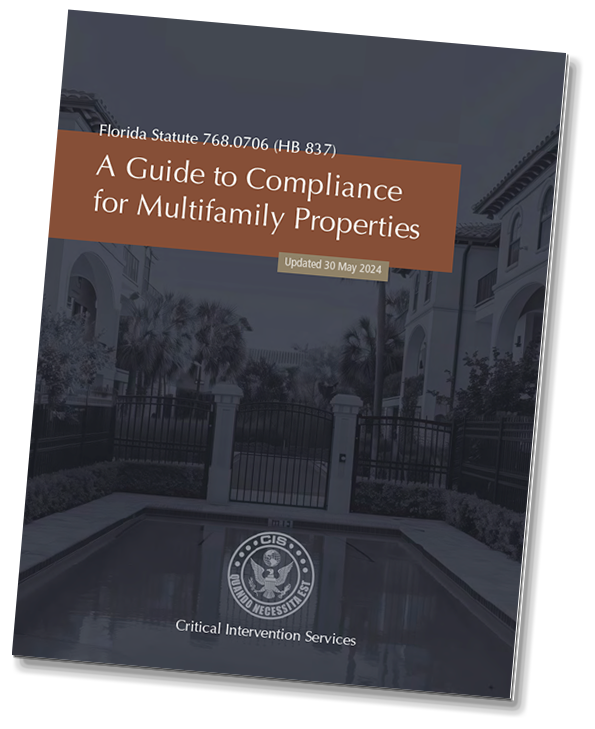
Download a PDF version of our guide to compliance with Florida Statute 768.0706